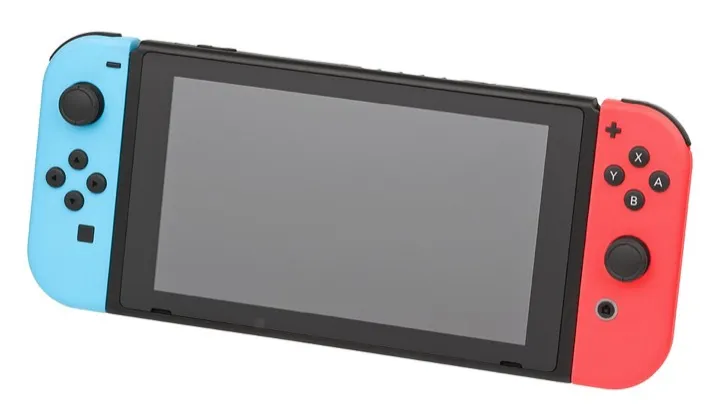
Nintendo Switch
A hybrid gaming device unveiled by Nintendo in 2017, seamlessly blending home console and portable gaming. The detachable Joy-Con controllers enable three play styles: TV Mode connected to a display, Tabletop Mode using the kickstand, and Handheld Mode with controllers attached. This versatility redefined how and where people play games.
RANKINGTop 10 best-selling games
How it is ranked: Worldwide sales (from the English Wikipedia list)
 楽天
 楽天
 楽天
 楽天
 楽天
 楽天
 楽天
 楽天

What is it?
The Nintendo Switch represents a fundamental rethinking of game hardware design. Rather than asking whether players prefer home consoles or portables, Nintendo created a device that transforms between both. The system includes a dockable main unit featuring a 6.2-inch display (OLED in newer models) flanked by detachable Joy-Con controllers. Snap the Joy-Cons onto the unit for handheld gaming, stand the tablet upright using the built-in kickstand for tabletop play, or insert the unit into the dock for full-screen TV gaming. Each mode feels native, not compromised.
The Joy-Cons themselves feature HD Rumble, a sophisticated haptic feedback system translating on-screen physics into subtle vibrations. This isn't crude rumbling—players feel the weight of individual ice cubes in a glass. USB-C charging enables fast power replenishment and universal cable compatibility. Since launch, Nintendo released variants: the Switch Lite in 2019 focused on portable play at a lower price point, and the Switch OLED in 2021 targeting premium users with an improved screen. Each iteration addressed different audience segments without fragmenting the library.
Why it was created
Nintendo spent 2015 reconsidering its future. The company had always maintained separate teams for home consoles and handhelds, but internal analysis suggested the boundary was eroding. Instead of competing with themselves, why not merge these platforms? The concept became 'play anywhere, anytime, with anyone'—continuous gaming from commute to home without friction.
In October 2016, Nintendo formally unveiled the Switch, codenamed 'NX.' Development partnered with NVIDIA to create a custom processor achieving high performance within limited power budgets. The ¥29,980 price point (~$300 USD) positioned it affordably compared to competitors, targeting both casual and serious gamers. The name itself emphasized the device's defining feature: switching seamlessly between modes. When lead designer passed away before launch, no one revealed the naming origin, adding mystique to the device's identity.
Why it succeeded
The Switch erased a false choice players had faced: home or portable. By offering both, it captured audiences entire platforms previously missed. Players no longer abandoned games during commutes or resumed elsewhere on weaker hardware. Launch lineup mattered enormously—Breath of the Wild and Mario Odyssey attracted hardcore gamers, while 1-2-Switch demonstrated motion control appeal. First-month sales reached 2.74 million units, exceeding Nintendo's 2 million projection.
Iterative variants broadened appeal without fragmenting software. The Lite captured price-conscious buyers; the OLED satisfied upgrade seekers. Online infrastructure matured, multiplayer became frictionless, and first-party titles maintained yearly momentum. By February 2022, the Switch had shipped 100 million units—more than any other Nintendo home console. This success reshaped industry expectations about device form factors and the false boundary between portability and power.
Things to know
The Switch maintained remarkable longevity. By July 2024, it surpassed the NES/Famicom's production lifespan of 2,686 days, becoming Nintendo's longest-supported home console. Nintendo Switch 2 launched in June 2025, yet the original remained relevant due to evergreen software and continued player investment.
Software ecosystem became the real differentiator. Zelda: Breath of the Wild didn't just showcase hardware—it redefined open-world game design industry-wide. Animal Crossing: New Horizons dominated during the COVID-19 pandemic's isolation period. Mario Kart 8 Deluxe became the system's best seller. These titles sustained engagement for years, creating a virtuous cycle where hardware sales drove software adoption and vice versa. By early 2026, the Switch had sold 155.37 million units total, making it the best-selling console by significant margin in gaming history.
Specs
| CPU | NVIDIA Tegra (custom variant) |
|---|---|
| Release date | March 3, 2017 |
| Launch price | ¥29,980 (Japan, manufacturer recommended) |
| Sales | 155.37 million units |
Sources
- English and Japanese Wikipedia articles on the Nintendo Switch