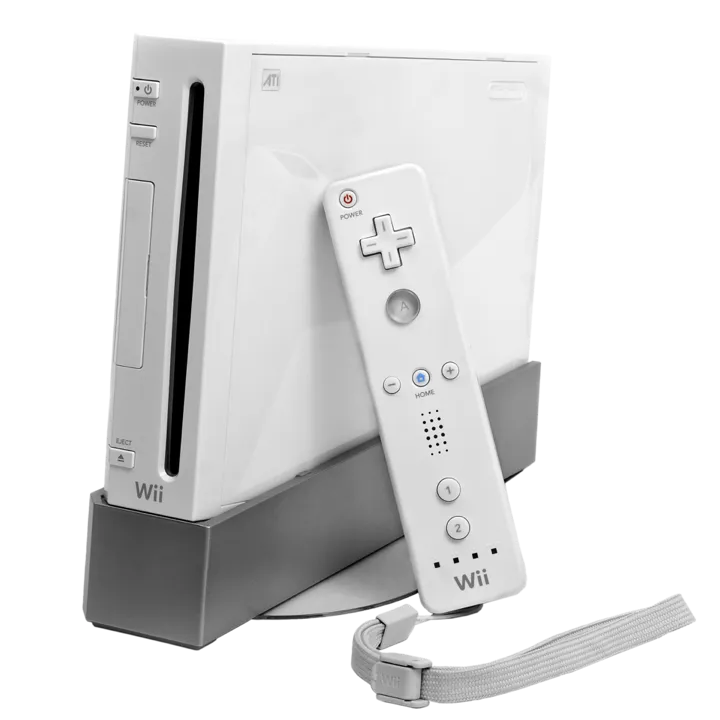
Nintendo Wii
A home video game console released by Nintendo in December 2006. The Wii Remote's intuitive motion control brought gaming to audiences far beyond traditional gamers, spanning all age groups. With more than 100 million units sold worldwide, it stands as one of the most important hardware platforms in video game history.
RANKINGTop 10 best-selling games
How it is ranked: Worldwide sales (from the English Wikipedia list)
 楽天
 楽天
 楽天
 楽天
 楽天
 楽天
 楽天

What is it?
The Wii is a home video game console released by Nintendo in December 2006. Its defining feature is the Wii Remote, a revolutionary controller that works through motion sensing rather than traditional button inputs. Players stand before a television and swing, tilt, or point the remote to control games—simulating the motion of swinging a baseball bat, a tennis racket, or rolling a bowling ball. The console's compact design houses an optical disc drive and SD card slot, making it significantly smaller than competing systems of its era.
The Wii became the first Nintendo home console to exceed 100 million units sold worldwide, introducing game design to multiple generations. Its success fundamentally changed how the industry thought about controller design and accessibility, proving that gaming could appeal to families, seniors, and casual players alongside hardcore enthusiasts. This shift in audience expanded the video game market itself, following the earlier success of the Nintendo DS handheld.
Why it was created
After the Nintendo DS became a massive hit in 2004, Nintendo sought to replicate that success in the home console market. The DS had attracted new and casual players with its touch screen innovation; now the company wanted to bring that same inclusive spirit to living rooms. The project, code-named 'Revolution,' was driven by a philosophy: create a machine that any family member, regardless of gaming experience, could pick up and enjoy.
Nintendo's leadership demanded hardware that was compact, simple, and energy-efficient. Under these constraints, the Wii Remote was born—a wireless stick-shaped controller with accelerometers and motion sensors. When first shown publicly at E3 2005, it stunned the gaming world. This wasn't an incremental improvement to button-based gaming; it was a fundamentally new way to play. The intuitive, gesture-based gameplay proved that you didn't need complex inputs or years of gaming knowledge to enjoy sophisticated interactive entertainment.
Why it succeeded
The Wii's breakthrough was the Wii Remote itself. By letting players swing, throw, and gesture to control games, Nintendo made gaming feel natural and inclusive. Someone who had never held a controller could understand how to swing a tennis racket or roll a bowling ball. The console brought gaming into social spaces—living rooms and family gatherings—where playing together became the default rather than an afterthought. Games like Wii Sports and later Wii Fit reached demographics that traditional gaming had never touched: grandparents, mothers, children, and people managing their health.
The launch lineup, particularly the inclusion of Wii Sports with most systems outside Japan, was crucial. Wii Sports became a cultural phenomenon, demonstrating the console's capabilities to millions while being instantly accessible. The steady supply of diverse software—from party games to fitness apps to traditional action titles—kept players engaged for years. This combination of revolutionary hardware, brilliant software, and genuine appeal to new audiences created a perfect storm that made the Wii the dominant console of its generation.
Things to know
The Wii Remote's design was refined over three years of research and development led by Shigeru Miyamoto's team, with countless iterations of shape and size before settling on a design anyone could comfortably hold and operate. Soon after launch, reports emerged of strap failures during play; Nintendo responded by creating and distributing protective jackets for all Wiimotes, a defining moment in gaming safety history. In October 2007, the company released Wii MotionPlus, an accessory that dramatically improved motion sensing precision, though supply shortages and scalping made it notoriously difficult to find.
The Wii remained in production until October 2013, years after the Wii U's debut, a testament to its enduring popularity. In Japan, software support continued until 2015, while Europe and other regions saw new releases through 2020. Despite this long lifecycle, the Wii's cultural legacy may matter more than any sales figure—it permanently changed how the industry thinks about controller design, accessibility, and who games are made for. Its influence on motion controls, gesture-based input, and inclusive game design remains visible across all gaming platforms today.
Specs
| CPU | IBM Broadway (PowerPC 750CL-based, clock frequency undisclosed) |
|---|---|
| Release date | December 2, 2006 |
| Launch price | ¥25,000 (Japan) |
| Sales | 12.74 million units (Japan) |
Sources
- English and Japanese Wikipedia articles on the Nintendo Wii