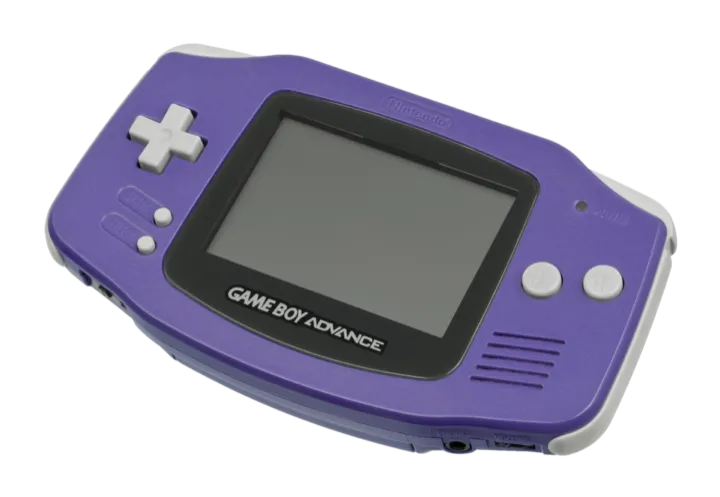
Game Boy Advance
Game Boy Advance introduced 32-bit processing to handheld gaming, delivering Super Famicom-quality graphics in a pocket-sized device. The system established technical standards for portable gaming that persisted for a decade, supporting both new titles and previous-generation Game Boy software.
RANKINGTop 10 best-selling games
How it is ranked: Worldwide sales (from the English Wikipedia list)
Pokémon Ruby and SapphirePokémon FireRed and LeafGreen 楽天
 楽天
 楽天Super Mario AdvanceSuper Mario Bros. 3 (GBA Version)
 楽天
 楽天
 Yoshi's Island: Super Mario Advance 3
What is it?
Game Boy Advance succeeded Game Boy Color with unprecedented technical capabilities for portable systems. The 32-bit ARM processor enabled graphical sophistication matching the Super Famicom generation—pseudo-3D rendering, transparency effects, and sprite scaling operations previously impossible on handheld devices. The 2.9-inch LCD screen displayed double the resolution of Game Boy Color while maintaining portable dimensions: 14.8 centimeters vertical, 8.1 centimeters horizontal. Game Boy Color compatibility allowed legacy cartridge playback, preserving software libraries while enabling forward progression to advanced titles.
The innovative design incorporated shoulder buttons (L and R), enabling simultaneous four-player wireless multiplayer through serial connectors. A 2003 revision introduced the Game Boy Advance SP, adding a clamshell design and front-lit display addressing the original model's visibility limitations in varying lighting conditions. Nintendo's commitment to backward compatibility meant Game Boy Advance cartridges remained playable on subsequent Nintendo DS hardware, extending the system's relevance across multiple console generations.
How it came about
Nintendo faced industry-wide 3D transition pressures affecting handheld development decisions. Early prototypes explored polygonal 3D rendering, but prototype manufacturing costs, battery consumption projections, and target retail pricing necessitated design reassessment. Nintendo ultimately selected 2D-focused architecture, a decision enabling Japanese developers with Super Famicom experience to transition directly without extensive retraining. This technical conservatism paradoxically accelerated quality software releases: established developers quickly adapted existing methodologies to enhanced hardware capabilities, producing diverse launch titles.
The development decision reflected confidence in 2D game design longevity despite industry 3D momentum. Nintendo's internal analysis determined that 2D sprite-based systems offered superior battery efficiency, manufacturing cost advantages, and developer familiarity compared to experimental 3D implementations. This pragmatic approach enabled aggressive pricing and rapid software library expansion, establishing market dominance through availability rather than technological experimentation.
Why it succeeded
Game Boy Advance fundamentally redefined handheld gaming by delivering console-quality experiences in portable form. The 32-bit processing enabled visual complexity approaching SNES-era standards while maintaining battery efficiency exceeding competing handhelds. Nintendo's franchise portfolio—Pokémon, Mario, Zelda—established immediately upon launch, providing compelling purchase justification across demographic segments. The handheld's first-week Japanese sales validated premium positioning through technical leadership.
International expansion reinforced the system's market dominance: North American sales exceeded 18 million units, establishing handheld gaming as mainstream entertainment. The wireless multiplayer infrastructure—enabling four-player gaming through cable connections—created social gaming environments differentiating Game Boy Advance from competing single-player-focused alternatives. Strong third-party publisher support ensured software diversity supporting varied preferences, with 81.51 million total hardware sales establishing record-setting handheld penetration.
Key facts
Game Boy Advance's strategic backward compatibility created unusual market dynamics: players could use previously purchased Game Boy and Game Boy Color software while accessing enhanced titles. This compatibility represented technical achievement—hardware accommodating multiple cartridge formats with different electrical specifications—while providing consumer value. Backward compatible architecture became Nintendo standard practice, influencing subsequent platform strategies where hardware retained playability for preceding-generation cartridges.
The original model's LCD screen visibility limitations in certain lighting conditions drove the 2003 Game Boy Advance SP redesign introducing front-lighting and clamshell mechanics. DS Lite, DSi, and DSi LL hardware maintained Game Boy Advance compatibility until the DSi XL dropped cartridge support, extending practical system support beyond twelve years. The robust hardware design ensured longevity—numerous units from 2001-2002 production runs remain functional two decades later. This reliability combined with handheld gaming standardization established Game Boy Advance as foundational to contemporary portable gaming infrastructure and developer practices.
Specs
| CPU | 32-bit ARM7TDMI (16.78 MHz) with 8-bit processor |
|---|---|
| Display | 2.9-inch LCD, 240×160 resolution, 32,768 colors |
| Memory | 32KB RAM plus 256KB external memory |
| Release | March 21, 2001 (Japan); June 11, 2001 (North America) |
| Price | ¥9,800 (Japan); $99 (North America) |
Sources
- English and Japanese Wikipedia articles on the Game Boy Advance