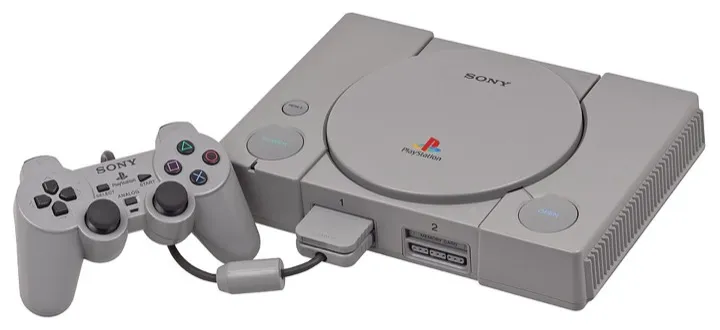
PlayStation
The PlayStation brought genuine 3D graphics to home gaming and forever changed how console games are made. With performance rivaling workstation computers, Sony created a new era of gaming that set the standard for the industry.
RANKINGTop 10 best-selling games
How it is ranked: Worldwide sales (from the English Wikipedia list)
 楽天
 楽天
 楽天
 楽天
 楽天
 楽天
 楽天

What is it?
The PlayStation, released by Sony Computer Entertainment on December 3, 1994, revolutionized home gaming by bringing true 3D graphics to the living room. At a time when 3D was considered far beyond the reach of home consoles, Sony pursued an aggressive strategy that brought cutting-edge graphics to the masses. By adopting CD-ROM technology instead of cartridges, the system achieved unprecedented storage capacity, lower manufacturing costs, and faster time-to-market. The innovative grip-style controller with its triangle, circle, cross, and square button layout became the industry standard and remains in use today. The ¥39,800 price point was steep for a home console, but consumers recognized its value reflected the device's power.
The internal architecture drew inspiration from professional computer graphics workstations. Its 32-bit RISC processor combined with a vector calculation unit (GTE) enabled fast 3D polygon rendering. The processor operated at 33.8688 megahertz, delivering approximately 30 megabytes per second of bus bandwidth. The system featured 2 megabytes of main RAM, 1 megabyte of video memory, and 512 kilobytes of audio memory.
How it came to be
The PlayStation story began as a collaboration between Nintendo and Sony. A team led by Ken Kutaragi proposed adding a CD-ROM drive to the Super Famicom, but Nintendo declined and chose to partner with Philips instead. Undeterred, Kutaragi and his colleagues at Sony pressed forward independently. The 1990s console wars erupted, and Sony emerged victorious, ultimately overtaking Nintendo's market leadership. On June 1, 1991, the PlayStation prototype was unveiled at the Consumer Electronics Show, shocking the gaming industry.
The development team faced fierce internal resistance. Many Sony employees opposed entering the game business, and Kutaragi himself was labeled a misfit. The turning point came when then-Sony President Norio Ohga uttered a single phrase: 'DO IT!' This became the project's catalyst. On November 16, 1993, Sony Computer Entertainment was formally established as a subsidiary.
Why it succeeded
PlayStation's success came not from hardware alone but from legendary software. Major publishers brought landmark titles: Square delivered Final Fantasy VII and Dragon Quest series, giving players games they absolutely wanted. The console's overwhelming 3D graphics performance was revolutionary. The CD-ROM format offered massive capacity at low cost, liberating game design from cartridge constraints and fundamentally transforming game distribution. The launch title Ridge Racer showcased the hardware's potential and captivated both gamers and industry observers.
Marketing strategy proved equally innovative. Sony adopted record-label distribution channels, gaining retail advantages its competitors couldn't match. Television commercials broke from gaming tradition, appealing to adult audiences with unexpected situations rather than game footage. First-year sales targets of 3 million units were dramatically exceeded.
Fun facts
Though revolutionary, the PlayStation's fixed-point arithmetic created visible seams between polygons—a quirk that became part of its charm and nostalgia. Memory cards eliminated the fear of losing saves to dead batteries, a genuine concern before. These cards held 128 kilobytes and could store up to 15 game files. The 24-channel audio chip incorporated sound technology that influenced Super Famicom's own audio. CD media featured an infrared-absorbing dye layer, making legitimate discs easily distinguishable from counterfeits.
Production eventually exceeded 100 million units. Even after the PS2 launched, Sony continued manufacturing the budget 'PS one' model. This overwhelming commercial success established PlayStation as a platform that would define gaming for the next generation.
Specs
| Processor | 32-bit RISC CPU running at 33.8688 megahertz |
|---|---|
| Release | December 3, 1994 in Japan |
| Price | ¥39,800 at launch |
| Units shipped | Over 102 million worldwide |
Sources
- English and Japanese Wikipedia articles on the PlayStation