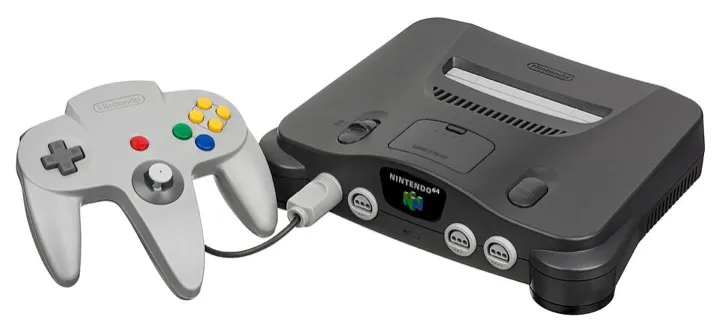
Nintendo 64
The Nintendo 64, released in 1996, was Nintendo's first major home console to deliver true 3D gaming. Developed with Silicon Graphics (SGI), it pioneered full 3D gameplay with its innovative analog stick controller. The system recorded strong international sales, particularly in North America, though the cartridge format limited game size compared to CD-based competitors.
RANKINGTop 10 best-selling games
How it is ranked: Worldwide sales (from the English Wikipedia list)
 楽天
 楽天
 楽天
 楽天
 楽天
 楽天
 楽天
 楽天

What is it?
The Nintendo 64 was a revolutionary gaming machine featuring a curved, ergonomic design distinct from previous flat console layouts. It was the first consumer hardware to comprehensively support 3D rendering through partnership with Silicon Graphics, a company renowned for high-end computer visualization. The signature innovation was the controller's center-mounted analog stick, enabling fluid 360-degree character movement in three-dimensional spaces—a paradigm shift from the fixed digital pads of earlier gaming generations.
The system featured four controller ports as standard, allowing simultaneous four-player gameplay without additional hardware adapters. Games arrived on ROM cartridges, enabling rapid data transfer approximately 36 times faster than CD-ROM media at the time. An optional Memory Expansion Pak doubled the machine's RAM from 4.5MB to 9MB, enhancing visual quality in compatible titles. The controller's three-pronged grip design accommodated multiple holding positions, each enabling different gameplay styles suited to specific titles.
How it came about
Nintendo partnered with Silicon Graphics in August 1993 following discussions initiated by SGI leadership, who sought to expand their proprietary MIPS architecture into mass consumer markets. At this time, director Shigeru Miyamoto of Nintendo was simultaneously conceiving 3D gaming possibilities after developing Star Fox on the Super Famicom. The collaboration, nicknamed Project Reality, aimed to bring workstation-class computer graphics technologies to affordable home entertainment. Development of the system proceeded in parallel with its flagship title Super Mario 64, with Nintendo sending developers to SGI's facilities to optimize hardware capabilities for interactive gameplay.
The console faced a two-month delay from its originally scheduled April 1996 launch, with Nintendo president Hiroshi Yamauchi granting creator Shigeru Miyamoto additional time to refine game design and graphical presentation. International expansion followed: the system launched in North America on September 26, 1996, where initial shipments of 350,000 units sold out within three days. The machine recorded 20.63 million total sales in North America alone, while domestic Japanese sales remained modest at 5.54 million units, reflecting stronger international market reception.
Why it succeeded
The Nintendo 64's breakthrough lay in establishing the analog stick as an industry standard for 3D games, transforming player expectations about spatial control. Super Mario 64 demonstrated this innovation through intuitive camera control and free movement, immediately influencing the broader gaming industry toward 3D development. Strong first-party software releases—including GoldenEye 007, The Legend of Zelda: Ocarina of Time, and Mario Kart 64—sustained hardware momentum through diverse genres, from first-person shooters to adventure games.
The built-in four-player capability shaped Nintendo's market position in the party gaming segment. Major franchises like Mario, Zelda, and Pokemon transferred successfully to the platform, creating compelling reasons for purchase. By contrast, competitors' reliance on CD media, while offering greater storage, could not match the Nintendo 64's instant-access gameplay responsiveness. International success, particularly in North America and Europe, offset modest domestic Japanese performance, allowing Nintendo to maintain hardware profitability and development momentum.
Key facts
The cartridge format, despite enabling faster load times, imposed strict storage limits compared to competitor PlayStation's CD-ROM capacity of 650 MB. Game files typically ranged from 8 MB to 12 MB, preventing the inclusion of pre-rendered video sequences and high-fidelity audio that rival platforms offered. This technological constraint prompted major publishers like Square (now Square Enix) to abandon Nintendo platforms, with Final Fantasy VII's exclusive PlayStation release symbolizing industry consolidation around disc-based storage. Domestic Japanese sales reached only 5.54 million units, a significant decline from the Super Famicom's market penetration, though North American sales of 20.63 million units demonstrated strong international appeal.
Production ended in 2002 after cumulative sales of 32.93 million units worldwide—5.54 million in Japan, 20.63 million in North America, and 6.75 million elsewhere. The system's technical architecture, built on SGI's Reality Engine concept, included a custom MIPS processor capable of floating-point operations and perspective-correct polygon rendering. The controller's analog stick, revolutionary at launch, became a reliability concern over time, with prolonged use causing potentiometer wear that degraded accuracy. Despite these limitations, the Nintendo 64 fundamentally established 3D gaming conventions that influenced console design for subsequent decades.
Specs
| CPU | MIPS R4300i Custom (93.75 MHz) |
|---|---|
| Release | June 23, 1996 (Japan); September 26, 1996 (North America) |
| Launch Price | ¥25,000 (Japan); $199 (North America) |
| Total Sales | 32.93 million units |
Sources
- English and Japanese Wikipedia articles on the Nintendo 64