
Super Mario 64
スーパーマリオ64
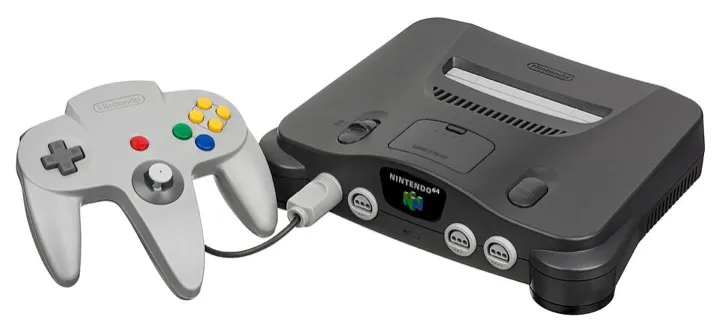
Nintendo 64's launch title redefined 3D platforming by placing Mario in a vast castle hub containing painting-portals to different worlds. Players collect Power Stars to unlock new areas and ultimately confront Bowser. The game's groundbreaking camera system and analog stick control became the template for 3D adventure games.
What is it?
Super Mario 64 places players in control of Mario within Princess Peach's castle and its interconnected worlds. Rather than following a linear path to a goal, players explore expansive environments and collect Power Stars—the castle's magical orbs now scattered across dozens of worlds. Each world contains multiple challenges: collecting 100 coins, defeating enemies, solving environmental puzzles, or racing opponents. The castle itself serves as a hub, with paintings acting as gateways to distinct themed worlds. Collecting 70 of 120 Power Stars unlocks the final confrontation with Bowser.
The game introduced unprecedented movement freedom through the analog stick, enabling Mario to walk, run, jump, crawl, climb, swim, and perform complex acrobatic maneuvers like triple jumps, long jumps, backflips, and wall jumps. A player-controlled camera, operated by an in-game character named Lakitu, could be positioned freely or switched to first-person perspective. Power-up caps—Wing Caps for flight, Metal Caps for underwater traversal and invulnerability, and Vanish Caps for phasing through obstacles—added variety to exploration and puzzle-solving.
How it plays
Gameplay emphasized experiential learning: players discover mechanics through environmental interaction rather than explicit instruction. The game's first levels taught camera operation and movement before increasing complexity. Each of the 15 courses contained multiple Power Stars with varying difficulty, encouraging replay and skill development. Successfully executing advanced movement techniques—precise jumps across narrow platforms, timing-dependent obstacle avoidance, or sequence-dependent puzzle solving—provided tangible progression feedback. Boss encounters required pattern recognition and tactical repositioning to expose vulnerabilities.
The game's design philosophy centered on spatial mastery and environmental discovery. Hidden areas rewarded exploration, bonus coins granted extra lives for sustained success, and secret Power Stars created long-term engagement hooks. Coins served dual purposes: currency for item mechanics and progress indicators, with special coins (red, blue, yellow) providing graduated rewards. The game supported multiple play sessions of varying length, from brief 10-minute star collections to extended exploration marathons.
Why it sold / trivia
Super Mario 64 launched alongside the Nintendo 64 itself in Japan and sold over two million copies within three months of North American release, establishing the console's early market momentum. The game's critical and commercial success validated Nintendo's vision of 3D gaming feasibility, directly influencing subsequent industry trends toward polygon-based environments. Game designers worldwide—from creators of Spyro the Dragon to Tony Hawk's Pro Skater—openly cited Super Mario 64's design principles as foundational references. Metacritic aggregated reviews yielded a score of 94 out of 100, ranking it among the highest-reviewed games of its generation.
The game's influence transcended immediate commercial success: it established camera control, analog stick movement, and mission-based level design as gaming standards for the 3D era. An enhanced Nintendo DS remake, Super Mario 64 DS, released in 2004, included additional playable characters and content, introducing the game to a new generation. By March 2008, Super Mario 64 had sold 11.8 million copies worldwide, becoming the Nintendo 64's best-selling title. The game's design legacy remains evident in contemporary 3D platformers, validating its designation as one of the most influential video game titles ever created.
Sources
- Best-seller list (English Wikipedia)
- Super Mario 64 (English Wikipedia)
- スーパーマリオ64 (Japanese Wikipedia)
How it is ranked: Worldwide sales (from the English Wikipedia list)
 楽天
 楽天
 楽天
 楽天
 Pokémon Stadium