
Mario Kart 64
マリオカート64
The franchise's second major installment brought Mario Kart racing to 3D environments with four-player simultaneous action. Characters from the Mario universe pilot distinct karts with varied performance characteristics, collecting power-up items to gain racing advantages in themed tracks.
What is it?
Mario Kart 64 expands the kart racing formula with fully three-dimensional tracks and environments. Players select from Mario franchise characters including Mario, Luigi, Yoshi, Peach, Toad, Donkey Kong, and Bowser, each operating a kart with individualized acceleration, top speed, and handling statistics. Four cups structure single-player progression, with each cup containing four tracks raced three times sequentially. Completion order determines race points, with championship standings calculated across all cups.
Gameplay centers on traversing tracks while collecting item boxes that dispense power-ups—green shells for rear attacks, red shells for forward targeting, banana peels for environmental hazards, mushroom boosts for speed surges, and star invincibility for temporary protection. Collision physics and track geometry create dynamic racing scenarios: shortcuts hidden behind walls, water hazards requiring precise navigation, and ramp-based shortcuts demanding skillful timing. Four simultaneous players add competitive chaos, with defensive item usage and blocking becoming critical survival strategies.
How it plays
Each race spans three laps across visually distinct environments—grassy meadows, sandy deserts, castle interiors, and snow-covered landscapes. Track design balances accessibility for novice players with skill-based routing options for experienced competitors. Item distribution mechanics ensure competitive balance: trailing racers receive more powerful power-ups while leaders receive defensive items, preventing runaway victories while maintaining tension throughout races. Momentum maintenance through drifting and boost-chaining adds technical depth rewarding player mastery.
The four-player simultaneous gameplay format emphasized local multiplayer engagement, with rubber-band catch-up mechanics ensuring dramatic final-lap reversals. Racing modes accommodated varied player counts and skill distributions through adjustable difficulty settings. Time trials enabled individual performance benchmarking, while battle modes (separate from main racing) featured arena-based item combat. Progressive unlocks rewarded consistent play, with hidden characters and tracks becoming available after championship victories.
Why it sold / trivia
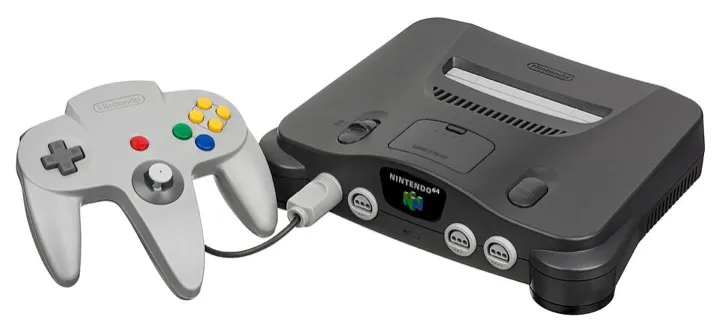
Mario Kart 64 leveraged the Nintendo 64's standard four-controller connectivity to deliver accessible local multiplayer gaming, differentiating itself from genre competitors focused on single-player experiences. The franchise's established popularity, combined with intuitive control schemes requiring minimal mechanical skill, broadened appeal across age demographics. The game's emphasis on party gaming dynamics—supporting casual social play alongside competitive racing—positioned it as a household entertainment staple rather than solely skill-based competition.
Sales reached 9.87 million copies by capitalizing on the Nintendo 64's install base and the party gaming market. The game established core mechanics that persisted across subsequent Mario Kart releases: item-based power-ups, character-specific performance differentiation, and four-player simultaneous support. Critical reception, while positive regarding gameplay mechanics and visual presentation, noted some limitations in track variety and single-player content depth compared to contemporary racing alternatives. Nevertheless, multiplayer popularity sustained long-term engagement, with Mario Kart 64 becoming a definitive social gaming experience for Nintendo 64 owners.
Sources
How it is ranked: Worldwide sales (from the English Wikipedia list)
 楽天
 楽天
 楽天
 楽天
 Pokémon Stadium