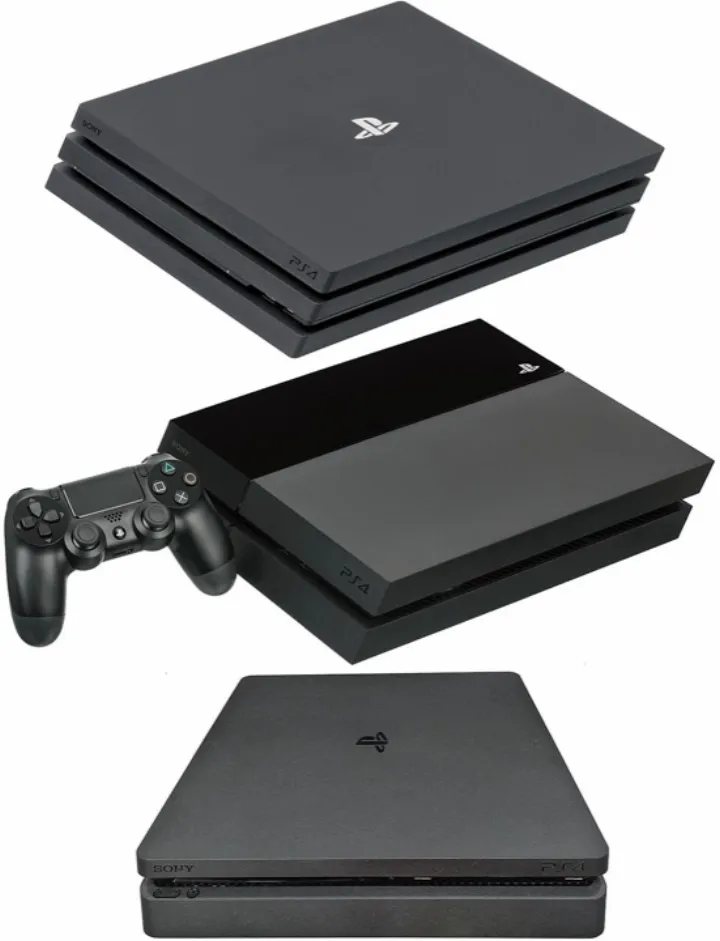
PlayStation 4
Sony's high-performance home console released in 2013. The eighth generation PlayStation, featuring an x86 architecture that made game development significantly more accessible.
RANKINGTop 10 best-selling games
How it is ranked: Worldwide sales (from the English Wikipedia list)
 楽天
 楽天
 楽天
 楽天
 楽天
 楽天
 楽天
 楽天
 楽天

What is it?
PlayStation 4 arrived as Sony's answer to a new generation of home consoles. Released in November 2013 in North America and early 2014 in Japan, the PS4 represented the eighth iteration of the PlayStation family. Unlike its predecessor, which relied on a custom Cell processor, the PS4 adopted a PC-style x86 architecture. This shift proved transformative: developers found the system significantly easier to work with, resulting in higher-quality games arriving more quickly after launch.
The console's technical foundation was built around an 8-core AMD processor paired with a dedicated AMD Radeon graphics unit capable of delivering 1.84 trillion floating-point operations per second. Eight gigabytes of GDDR5 memory supported the ambitious visual designs developers were already imagining. The initial model (CUH-1000) retailed for ¥39,980 in Japan. Later, a higher-end "PS4 Pro" model launched in November 2016, offering 4K resolution support for those seeking even greater visual fidelity.
Why it was made
PlayStation 3 had proven technically complex to develop for, with its unusual architecture creating friction between vision and execution. Sony's engineering teams studied where difficulty lay and chose a different path: embrace proven PC technology. An x86 processor meant developers wouldn't need specialized expertise just to build games for PlayStation. The formula worked. Studios could now target PlayStation, Xbox, and PC simultaneously, bringing their best work to all platforms.
The company's messaging strategy mattered too. At the 2013 reveal, Sony publicly committed to supporting used games and played down online restrictions—a stark contrast to Xbox One's initially draconian approach. Gamers responded with enthusiasm. The company showcased features built for the internet age: a Share button for capturing and broadcasting gameplay, streaming integration, and PlayStation VR compatibility. These weren't afterthoughts bolted onto the hardware; they were central to how the machine was designed.
Why it sold
The x86 foundation created a virtuous cycle. Developers released more games, more games meant more reasons to buy, and more console sales meant more developer interest. Major franchises migrated to the platform, and exclusive titles—Spider-Man, God of War, Horizon Zero Dawn—gave PlayStation fans exclusives that became system-sellers.
The Share button proved revolutionary. Pressing it once could capture and broadcast gameplay, and the industry was transformed. Twitch and YouTube exploded with PS4 content. The console's integration with streaming platforms wasn't perfect, but it was standard in a way competitors hadn't managed. PlayStation VR later extended the experience into virtual reality. Over its lifecycle, the PS4 accumulated thousands of released titles and became one of the most successful gaming platforms in history.
Key facts
The PS4 Pro, arriving three years into the original's lifecycle, delivered enhanced visual performance and 4K resolution support for compatible games, while the base model provided the standard 1080p experience. Pro owners paid a premium ¥44,980 initially.
The DualShock 4 controller introduced a touchpad, an integrated speaker, and a built-in share button—features that would influence PlayStation 5's design. The console remained in production for a full decade, making it one of the longest-supported gaming platforms ever created, and stands among the most successful gaming devices of all time.
Specs
| CPU | AMD Custom Jaguar (8 core) |
|---|---|
| GPU | AMD Radeon (1.84 TFLOPS) |
| Memory | GDDR5 8GB |
| Release date | November 15, 2013 (North America), February 22, 2014 (Japan) |
| Launch price | ¥39,980 (Japan) |
Sources
- English and Japanese Wikipedia articles on the PlayStation 4