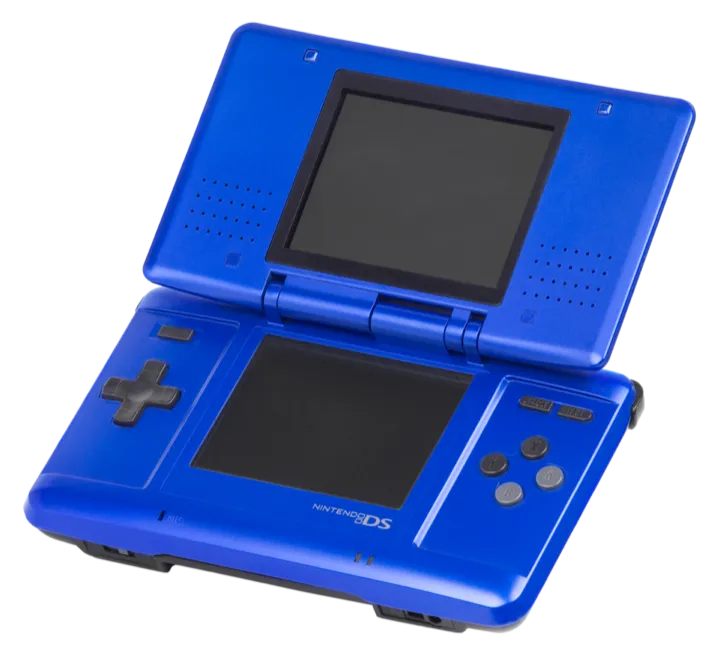
Nintendo DS
The Nintendo DS revolutionized handheld gaming through innovative dual-screen design and stylus input, establishing new interaction paradigms. Backward compatibility with Game Boy Advance software ensured software continuity while enabling novel gameplay possibilities through its unique hardware configuration.
RANKINGTop 10 best-selling games
How it is ranked: Worldwide sales (from the English Wikipedia list)
 楽天
 楽天
 楽天
 楽天
 楽天
 楽天

What is it?
Nintendo DS introduced revolutionary dual-screen architecture with the lower screen featuring touch-sensitive capacitive input enabled by stylus interaction. The clamshell design protected dual LCD displays during transport while maintaining compact portable dimensions. The integrated microphone enabled voice-input gaming mechanics absent from predecessor platforms. Dual processing architectures—separate ARM9 and ARM7 units—enabled sophisticated game logic execution alongside backward-compatible Game Boy Advance cartridge playback through proprietary slot mechanisms.
The innovative hardware design created asymmetric gameplay possibilities: players manipulated lower-screen content through stylus interaction while upper-screen elements displayed passive information or complementary visuals. The clamshell form-factor protected dual screens while creating distinctive silhouette recognizable across handheld gaming markets. Game Boy Advance backward compatibility ensured software library continuity, establishing market incentive for console adoption among existing cartridge owners.
How it came about
Nintendo's dual-screen concept emerged from design philosophy prioritizing interface innovation transcending hardware processing advances. Touchscreen research—examining capacitive and resistive technologies—established practical input methodologies differentiating Nintendo platforms from competitors pursuing processing-power escalation. The stylus interface created accessibility paradigms reaching casual audiences unfamiliar with traditional controller mechanics, broadening demographic appeal beyond hardcore gaming communities.
Development priorities emphasized software showcase potential: games demonstrating stylus interaction, dual-screen coordination, and microphone integration were greenlit for launch windows. Third-party publisher commitments to innovative gameplay concepts—rather than mere port translations—established software diversity supporting varied player interests. Strategic Game Boy Advance compatibility maintained backward-compatibility traditions established through previous Nintendo console transitions.
Why it succeeded
Nintendo DS achieved unprecedented handheld market penetration through interface innovation accessibility: stylus-based gameplay eliminated controller-learning barriers enabling casual audience adoption. The dual-screen design created visual richness and interactive possibilities transcending Game Boy Advance technical limitations. Touchscreen innovation—enabling direct-manipulation gameplay mechanics—fundamentally reshaped handheld gaming paradigms establishing conventions persisting across contemporary mobile platforms.
Sales dominance reflected software library depth: Pokémon Diamond and Pearl, Brain Age, Nintendogs, and Animal Crossing appeal spanned demographics from hardcore gamers to casual audiences seeking entertainment beyond traditional gaming. The system achieved 154.02 million unit sales, establishing record-setting handheld sales dominance. Innovation accessibility—enabling participation from non-traditional gaming audiences—distinguished DS from competitor platforms reliant on processing-power positioning.
Key facts
The DS introduced brain-training gaming concepts through Brain Age titles: scientifically-grounded mental exercise presented as entertainment demonstrated gaming's potential beyond entertainment-entertainment purposes. Nintendogs capitalized on virtual-pet mechanics popularized through Tamagotchi and Pokemon: stylus-based pet interaction created tactile engagement absent from traditional button-based control. Animal Crossing Wild World established long-term engagement through time-based progression: players returned repeatedly across months and years maintaining virtual environments.
Game Boy Advance cartridge compatibility—unique among Nintendo successors—enabled seamless software transition while establishing DS supremacy through dual-library access. The system's multitap-expansion capabilities enabled four-controller support, maintaining Nintendo's local-multiplayer emphasis. Multiple hardware revisions—DS Lite, DSi, DSi XL—refined design through improved screen brightness, built-in cameras, and enhanced audio, extending market appeal through iterative hardware improvements. Retrospective analysis credits DS with establishing contemporary handheld gaming conventions: dual-screen design, touchscreen integration, and casual-gaming accessibility fundamentals persist across contemporary handheld platforms.
Specs
| Display | Dual 3.15-inch LCD screens, 256×192 resolution each |
|---|---|
| CPU | ARM9 and ARM7 processors |
| Input | Touch screen stylus, microphone, dual controllers |
| Release | November 21, 2004 (Japan); March 11, 2005 (North America) |
| Price | ¥15,000 (Japan); $199 (North America) |
Sources
- English and Japanese Wikipedia articles on the Nintendo DS