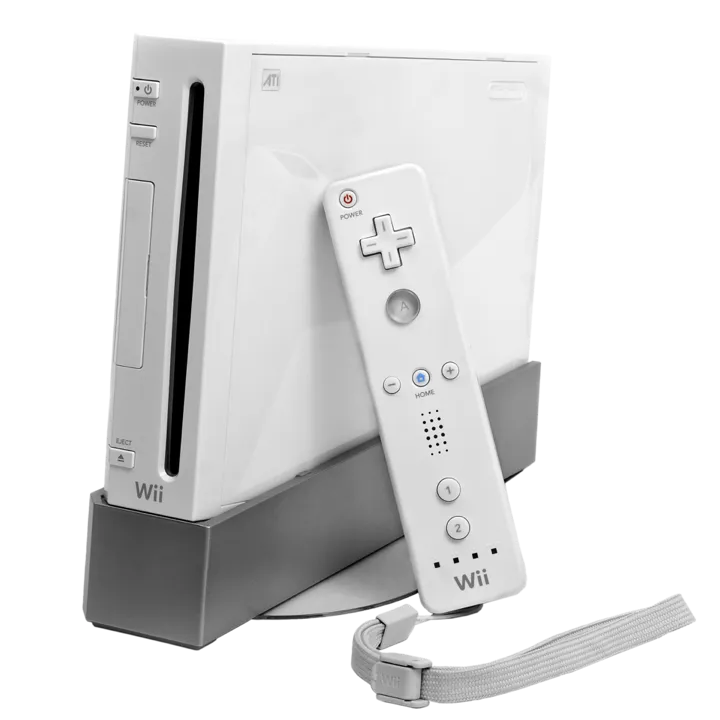
 Wii Fit
Wii Fit
A motion-controlled fitness game using the Balance Board accessory. With 40+ exercise programs including yoga, strength training, and aerobics, it transformed gaming into health management.
What is it?
Wii Fit pairs the Wii with the Balance Board, a digital scale-like platform that detects weight distribution and body position. Standing on it, the console calculates your center of gravity and tracks over 40 exercise routines spanning yoga, strength training, balance games, and aerobics. Your age, height, and weight establish your Wii Fit Age—a numerical measure of your fitness level relative to your actual age. Daily exercise aims to lower your Wii Fit Age toward zero. A trainer character—customizable appearance—guides each routine, and the game tracks daily weight, exercise history, and progress through graphs.
This wasn't marketed as a game first. Nintendo explicitly positioned Wii Fit as a health management tool. The Balance Board became the centerpiece, and the gaming elements supported motivation rather than being the point. You couldn't ignore your weight history or daily activity levels; the game insisted on numerical accountability.
How it plays
Yoga routines teach breathing control and flexibility through slow, guided stretches displayed on-screen. You maintain poses while the trainer corrects your position detected through the Balance Board's weight sensors. Strength Training targets specific muscle groups—crunches for abs, lateral raises for shoulders—with rep counting. Balance activities present puzzle-like challenges where you tilt your body to maneuver virtual objects across the screen. Aerobics ranges from simple step routines to more intense dance-like movements.
Difficulty levels within each routine let you progress gradually. A beginner yoga session feels accessible; the expert variant demands serious flexibility. Completing exercises unlocks cosmetic rewards like new Mii outfits or custom trainer appearances, creating soft progression. Competitive elements let you compare your Wii Fit Age or high scores with friends' devices, introducing social accountability.
Why it sold
Wii Fit arrived in 2007, during a period of rising health consciousness in developed nations. The concept of gamifying fitness, turning exercise into quantifiable, rewarding progress, resonated widely. Initial shortages created scarcity-driven demand; people camped store shelves hunting for the Balance Board. Older adults, traditionally underserved by gaming, discovered it in gyms, physical therapy clinics, and senior centers. Healthcare studies published papers examining Wii Fit's effectiveness. Suddenly, gaming wasn't just for youth; it became a health intervention.
Women, who comprised a minority of video game buyers, adopted Wii Fit enthusiastically. The message—'Improve your health through play'—felt less like gaming and more like empowerment. The Balance Board became an icon, more recognizable to mainstream audiences than the Wii itself. Despite criticisms about accuracy and the fitness gains' magnitude, Wii Fit achieved something profound: it made health tracking feel fun, bringing millions of non-gamers into the console's ecosystem.
Sources
How it is ranked: Worldwide sales (from the English Wikipedia list)
 楽天
 楽天
 楽天
 楽天