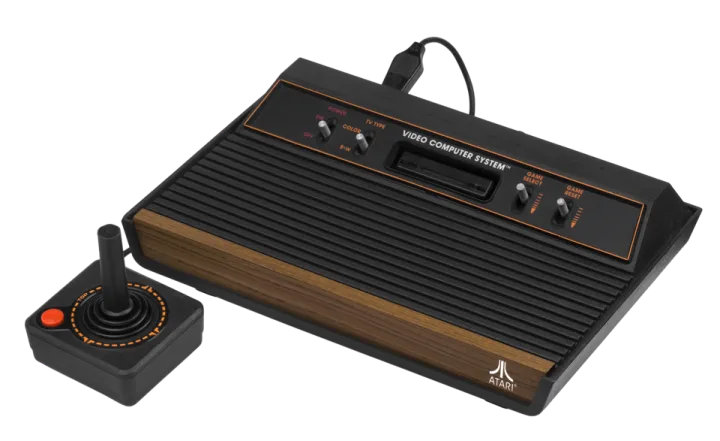
Atari 2600
Release date: September 11, 1977 (North America), October 8, 1979 (Japan)
Released by Atari in 1977 as the Video Computer System (VCS, later renamed 2600), this console revolutionized home gaming by introducing interchangeable cartridge-based software. With only 128 bytes of RAM and a modest processor, developers pushed the hardware's limits through ingenious optimization. When Taito's Space Invaders arrived as a home port in 1980, it transformed the 2600 from curiosity into phenomenon, establishing the template for the entire home gaming industry and generating billions in revenue before the console's production ended in 1992.

RANKINGTop 10 best-selling games
How it is ranked: Worldwide sales (from the English Wikipedia list)
Pac-ManSpace InvadersDonkey KongPitfall!AsteroidsDefenderE.T. the Extra-TerrestrialMs. Pac-ManDemon AttackNight DriverWhat is it?
The Atari 2600 introduced the cartridge-based console model that would define home gaming for decades. Rather than a fixed set of built-in games like earlier systems, the 2600 accepted interchangeable ROM cartridges, allowing one piece of hardware to play dozens of different games. This innovation created a secondary software market that fundamentally changed the industry's economics and longevity.
The hardware pushed extreme economy—a Mostek 6507 running just 1.19 MHz with only 128 bytes of RAM represented severe technical constraints by modern standards. Graphics and sound abilities were correspondingly modest. Yet Nolan Bushnell and Joseph Decuia engineered a system capable of accommodating creative solutions despite these limitations. Jay Miner's Television Interface Adapter (TIA) generated impressive audio and visuals given the constraints. Output connected to standard televisions, with bundled joystick controllers as the primary interface. The beige exterior housed clever engineering—programmers employed sophisticated multiplexing and even repurposed CPU cycles to work within the memory ceiling, often using the processor itself as makeshift storage.
Why it was made
Atari initially focused on arcade cabinets and home versions of its Pong franchise, but competition was intensifying as the mid-1970s progressed. Company leadership recognized that a cartridge-based system could extend hardware lifespan indefinitely if sufficient software existed, unlike dedicated systems which could only play pre-programmed titles.
Development proceeded under the codename 'Stella,' named after a bicycle belonging to lead designer Joseph Decuia. Atari explored using Motorola's advanced processors, but cost constraints ultimately led to adoption of the more affordable Mostek 6507, a cost-reduced variant of the 6502 architecture. This decision, initially viewed as compromise, proved fortunate—the simpler processor forced developers toward elegant optimization and creative engineering that became the system's hallmark. Marketing began in earnest in 1977, with an October 1977 launch date set for the Christmas season. Early sales disappointed, however, as consumers failed to understand why they should purchase expensive cartridges for limited games.
Why it was a hit
When Taito's Space Invaders made the jump to cartridge form in March 1980, the system's fate changed dramatically. Rick Morrall's programming distilled the arcade's 55-alien formations into a 36-entity 2600 rendition while preserving the essential gunplay. Demand surged—over 1.1 million copies shipped within months, exponentially expanding the user base. The years 1980-1981 saw annual cartridge sales climbing past the million-unit mark, confirming the 2600's market supremacy.
Third-party developers soon recognized the cartridge platform's profitability. Activision, founded by former Atari programmers, led the charge with successful titles that proved outside developers could succeed despite modest hardware. This ecosystem expansion accelerated software variety exponentially. By 1982, the 2600 controlled an estimated 70% of the home console market. Marketing momentum, combined with continued arcade-to-home ports and original development, sustained the platform's growth through the mid-1980s.
Good to know
The 1982-1983 period brought crisis that threatened the 2600's survival. Pac-Man, along with E.T. the Extra-Terrestrial, both releases with enormous pre-launch expectations, failed to meet sales targets. E.T. proved especially problematic when massive inventory miscalculations led to millions of unsold cartridges destined for a New Mexico burial site. This pivotal moment, known as the 'Atari Shock,' triggered industry predictions of imminent gaming market collapse.
Yet the 2600 endured thanks largely to Nintendo's 1985 Nintendo Entertainment System, which re-established consumer trust through rigorous quality standards and compelling software. While the 2600 ceded market leadership, the platform remained economically viable through 1992. Cumulative sales reached approximately 30 million units across all models and regions, with the Japan-specific 2800 variant adding to global reach. The extended fifteen-year production run—a remarkable achievement—fundamentally established home gaming as a viable industry category.
Specs
| Processor | Mostek MOS 6507 (1.19 MHz) |
|---|---|
| Memory | 128 bytes of RAM |
| Release date | September 11, 1977 (North America), October 8, 1979 (Japan) |
| Launch price | $199 (North America), ¥57,300 (Japan) |
| Total sales | Approximately 30 million units |
Sources
- English and Japanese Wikipedia articles on the Atari 2600