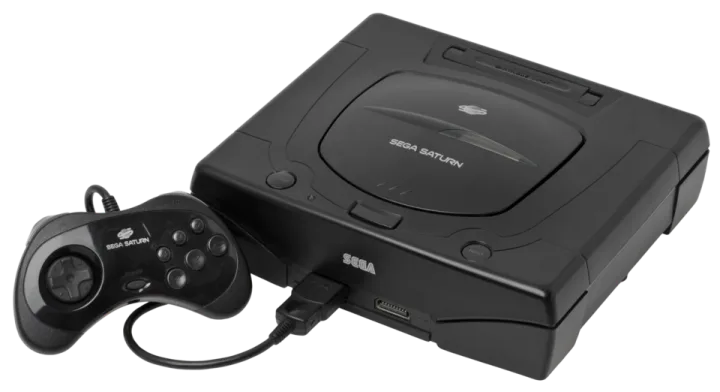
Sega Saturn
Release date: November 22, 1994 (Japan)
Sega released the Saturn on November 22, 1994, as its entry into the fifth generation of home consoles. With dual CPUs and a focus on 2D prowess, the Saturn powered through the arcade-to-home transition of the mid-1990s. Its architecture emphasized sprite handling and background scaling, making it the console of choice for arcade ports. The Saturn succeeded in Japan, where it became Sega's most successful home console ever, eventually selling roughly 10 million units worldwide despite struggles in North America.
RANKINGTop 10 best-selling games
How it is ranked: Worldwide sales (from the English Wikipedia list)
Virtua Fighter 2Virtua FighterSega Rally ChampionshipVirtua CopDaytona USAGrandiaWhat is it?
The Sega Saturn is a 32-bit home console built on a dual-processor architecture. Its defining characteristic is formidable 2D graphics capability through two video processors: one for sprites and transformations (VDP1) and one for scrolling backgrounds (VDP2). The system supports five independent background layers with rotation and scaling, enabling effects that rivals struggled to match. While 3D polygon performance lagged behind competitors' specialized graphics processors, the Saturn's 2D power made it the preferred platform for bringing arcade games to home systems. The hardware launched in gray in 1994, then was reissued as the white Saturn in 1996, with a skeleton translucent variant following later.
The Saturn's internal architecture distributes processing across nine processors to achieve a theoretical 800 MIPS. The main dual-CPU design allowed splitting tasks between processors, though coordinating them required careful programming. CD-ROM storage held games in a proprietary format with copy protection. Cartridge expansion slots allowed publishers to add RAM or ROM modules for specific titles. The standard controller featured six action buttons arranged differently from competitors, establishing a layout that influenced fighting game pad design for years to come.
Why it was made
During Saturn's development, 3D polygon gaming appeared unlikely to dominate. Research suggested that game libraries would remain largely 2D for the foreseeable future. Consequently, Sega designed the Saturn to be, in the words of its development philosophy, 'a Genesis in disguise'—a dramatic upgrade to 2D technology rather than a radical shift to 3D. As competition materialized, with PlayStation's 3D prowess becoming clear, Sega hastily added a second CPU to improve geometry processing. This reactive engineering decision increased complexity and cost, contributing to the Saturn's production challenges.
The decision to use CD-ROM media reflected industry trends toward larger storage and lower costs compared to cartridges. Arcade operator Sega, with MODEL2 hardware achieving breakthrough 3D graphics, initially saw the Saturn as a bridge. The sudden focus on competing with PlayStation's 3D performance forced design compromises: the second CPU wasn't optimally integrated, leaving developers with a system powerful but demanding to program. Sega's arcade heritage meant numerous MODEL2 games awaited porting, an advantage that would define much of Saturn's early library.
Why it was a hit
The Sega Saturn became a powerhouse in Japan through arcade ports and domestic developer support. Sega's arcade division, sitting on a mountain of MODEL2 hits like Virtua Fighter, Virtual Cop, and Daytona USA, ensured the Saturn received impressive conversions of proven arcade successes. These weren't budget ports but thoughtful adaptations that respected the arcade originals while leveraging the Saturn's 2D prowess. The system's 2D superiority made arcade-to-home transitions smoother than competitors could manage, a crucial advantage in regions with strong arcade cultures.
Japanese support from third-party developers ensured a steady supply of innovative software. Fighters, horizontal shooters, and action games leveraged the system's 2D power. Compatible versions from Victor and Hitachi expanded retail distribution beyond traditional game shops into electronics stores, broadening market reach. By contrast, North America saw the system stumble due to supply issues at launch, marketing missteps, and PlayStation's $299 price point against Saturn's higher cost. The result was a sharply divided global market, with Japan embracing the Saturn while North America increasingly favored PlayStation.
Good to know
The Sega Saturn experienced a major split in market performance: Japan and Europe saw reasonable success, while North America struggled. Sega's surprise announcement of a May 1995 North American launch, made without telling retailers, created friction in the channel and reduced launch retailer enthusiasm. By contrast, PlayStation's staged availability and careful marketing built anticipation. The surprise launch timing ultimately hurt Saturn more than it helped, spoiling relationships with key retail partners.
Later in its lifecycle, Saturn production ended in Japan in December 1999, though distribution continued. The system spawned compatibility machines from Victor and Hitachi, expanding the installed base beyond Sega's direct hardware sales. The Saturn's legacy shifted over time: while initially seen as a failure outside Japan, it's now appreciated for its arcade heritage, technical ingenuity, and the creativity its developers brought to 2D gaming. The system remains a favorite among collectors and enthusiasts who value its strong first-party support and unique architectural character.
Specs
| CPU | 2× Hitachi SH-2 (28.64 MHz) |
|---|---|
| Release date | November 22, 1994 (Japan) |
| Launch price | ¥44,800 (Japan) |
| Total units sold | 10 million |
Sources
- English and Japanese Wikipedia articles on the Sega Saturn