 Virtua Fighter
バーチャファイター
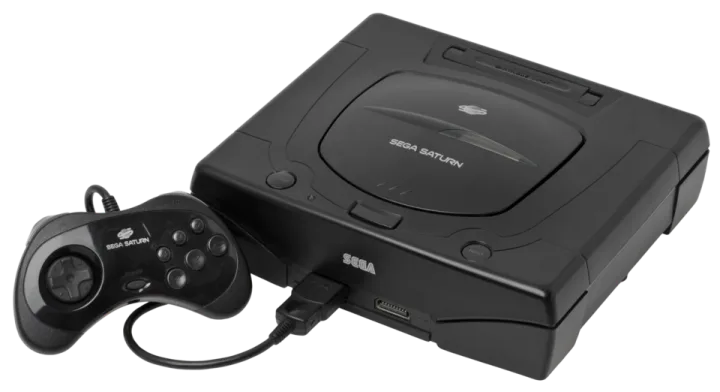
Sega's original Virtua Fighter launched alongside the Saturn on November 22, 1994, as a system-launch title. This pioneering 3D fighting game introduced fully polygonal characters to home consoles, showcasing the Saturn's 3D capabilities despite the system's architectural bias toward 2D. The game sold 1.5 million copies, establishing the Saturn's fighting game pedigree from day one.
What is it?
Virtua Fighter is the original game that launched the 3D fighting game genre. Players select from eight martial artists—Ryu, Kage, Jacky, Sarah, Jeffry, Wolf, Akira, or Pai—each with distinctive movesets reflecting their martial arts discipline. The game presents matches in a square ring where victory comes through knock-outs or ring-outs. Character models are wireframe and flat-shaded, a technical aesthetic that nonetheless conveys surprising personality. Motion capture animation brings movement authenticity; watching Ryu execute a throw or Jacky perform a dropkick feels responsive and visceral.
The Saturn version adapts the arcade original faithfully while making allowances for the home platform. Arcade mode presents a progression of increasingly challenging opponents culminating in a final bout against Dural, the game's boss character. Training and practice modes let players hone their skills. The game established systems that would persist through sequels and competitors, earning it recognition as the foundation of 3D fighting.
How it plays
Virtua Fighter demands understanding each character's move set and reading opponent behavior. The game operates on a single button layout: punch, kick, and guard. Different combinations and directions unlock the character's special attacks. Throws provide defensive breakers for aggressive play, with execution requiring button combinations. Learning to chain hits into combos and understand frame advantage—the advantage one player gains after performing a move—forms the core competitive skill.
Difficulty scales appropriately through arcade mode, with opponents becoming tougher and employing more complex strategies as you progress. The ring environment introduces spatial awareness: knowing your position relative to ring edges and when you're at risk of ring-out becomes tactically important. Versus play supports head-to-head competition, making the game suitable for sustained engagement.
Why it sold / trivia
Virtua Fighter sold 1.5 million copies despite arriving at a time when many potential customers were waiting for more visually impressive alternatives. Its reputation as the arcade game that pioneered fully 3D polygon fighters drove sales among tech enthusiasts and arcade fans. The Saturn launch lineup emphasized arcade ports, with Virtua Fighter as the flagship example of that strategy.
The game's success set a precedent: arcade-perfect (or near-perfect) ports of Sega arcade games would define Saturn's early appeal. Virtua Fighter proved that cutting-edge arcade experiences could arrive on home systems, though at a slight visual and performance cost compared to arcade cabinets. The game launched a franchise that would see multiple sequels across multiple platforms, cementing Virtua Fighter's place as a foundational fighting game series.
Sources
- Best-seller list (English Wikipedia)
- Virtua Fighter (video game) (English Wikipedia)
- バーチャファイター (Japanese Wikipedia)
How it is ranked: Worldwide sales (from the English Wikipedia list)