Sega Genesis (Mega Drive)
Release date: October 29, 1988 (Japan)
In late 1988, Sega launched the Mega Drive in Japan as a 16-bit home console. Known as the Genesis in North America, it gave Sega a real challenge to Nintendo, and by January 1992 Sega held 65% of the 16-bit console market. The system thrived in North America and Europe, where aggressive marketing and hit franchises made it a cultural force.
RANKINGTop 10 best-selling games
How it is ranked: Worldwide sales (from the English Wikipedia list)
Sonic the HedgehogSonic the Hedgehog 2Sonic the Hedgehog 3Mortal KombatDisney's AladdinJohn Madden Football '93NHL '94Joe Montana FootballJurassic ParkNBA JamWhat is it?
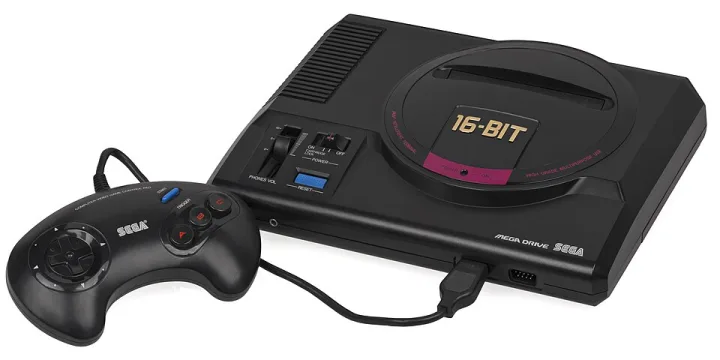
The Sega Genesis—known in Japan and Europe as the Mega Drive—is a 16-bit home video game console built around a Motorola 68000 processor as its main CPU and a Zilog Z80 for sound and peripheral control. The machine launched with capabilities that felt cutting-edge in 1988. The white-and-black design was compact and professional-looking, intended to appeal to a broad audience beyond traditional gamers.
Games arrive on ROM cartridges, with early titles stored on 1 megabit media expanding to 4, 8, and even 32 megabits by the console's later years. The system supports a simple controller with a D-pad and three primary buttons (A, B, C), later joined by a 6-button variant that became standard for fighting games. Regional variants existed across markets, alongside licensed versions like the Super Gam*Boy in Korea.
Why it was made
By the mid-1980s, Sega's arcade business was booming, but its home console efforts—the Mark III and Master System—struggled against Nintendo's dominance. Sega's executives recognized that a leap to 16-bit technology could change the market equation. Development began in 1986 under the codename 'Mark V,' and Sega settled on the Motorola 68000 processor primarily for cost considerations: by negotiating a volume purchase, Sega secured the chip at roughly one-tenth its market price, allowing the company to offer a powerful 16-bit console at an accessible price.
The timing was strategic. The Nintendo Entertainment System (NES) dominated the market, but the company's own next-generation system, the Super NES, was still in development and months away from launch. Sega saw an opportunity to establish a beachhead in the 16-bit era before Nintendo could respond, betting that aggressive marketing and arcade-quality ports would win over players hungry for home versions of Sega arcade hits.
Why it was a hit
In Japan, the Mega Drive competed directly against Nintendo's Super Famicom and NEC's PC Engine, ultimately finishing third in the region. However, in North America and Europe, the market dynamics favored Sega. By 1991, the Genesis was outselling the Super NES by a wide margin, driven by aggressive pricing, strong marketing that positioned the system as 'cool,' and the arrival of Sonic the Hedgehog. The tagline 'Genesis does what Nintendon't' became iconic, directly challenging Nintendo's market leadership.
Sega cultivated a diverse software library. Beyond arcade ports, the company invested in Western-developed titles, particularly sports games and action franchises that appealed to North American and European audiences. The 1991 holiday season cemented the Genesis's dominance—demand so exceeded supply that cargo planes hauled systems to retailers, and the console briefly commanded 65% of the 16-bit market. By the mid-1990s, the Genesis had sold over 30 million units worldwide, making it one of the best-selling consoles ever.
Notable features and later add-ons
The Genesis saw later peripheral releases like the Sega CD (1992) and 32X (1994), neither of which achieved commercial success. The Sega CD offered full-motion video capabilities but remained niche; the 32X promised 32-bit processing but arrived too late, cannibalizing Genesis sales rather than extending the console's appeal. These missteps contributed to confusion in the marketplace and fragmented developer focus.
Despite Japan's tepid response, the Genesis's legacy is outsized. The console introduced Sonic to the world, spawning a franchise that rivals Mario in longevity. It proved that marketing, software diversity, and regional adaptation could overcome Nintendo's seemingly insurmountable lead. Modern emulation and retro hardware rereleases keep the Genesis alive among enthusiasts, and many of its games—particularly Sonic, Altered Beast, and Gunstar Heroes—remain fondly remembered.
Specs
| CPU | Motorola MC68000 (7.67 MHz), Zilog Z80 (3.58 MHz) |
|---|---|
| Release date | October 29, 1988 (Japan) |
| Launch price | ¥21,000 |
| Units sold | approximately 3.58 million units (Japan) |
Sources
- English and Japanese Wikipedia articles on the Sega Genesis (Mega Drive)