PlayStation Portable
Release date: December 12, 2004 (Japan)
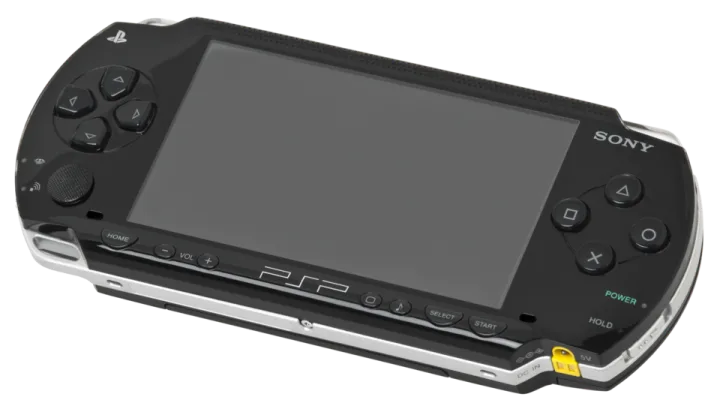
Sony released the PlayStation Portable on December 12, 2004, as the first handheld entry in the PlayStation family. With its 4.3-inch widescreen display and 32-bit processor, the PSP brought home-console-grade graphics to portable gaming. Its Universal Media Disc (UMD) format and built-in Wi-Fi enabled both games and movies. The PSP defined handheld gaming in its era through a combination of powerful hardware, a diverse software library, and the ease of local multiplayer over ad hoc wireless connections.
RANKINGTop 10 best-selling games
How it is ranked: Worldwide sales (from the English Wikipedia list)
Grand Theft Auto: Liberty City StoriesMonster Hunter Portable 3rdGran TurismoRatchet & Clank: Size MattersMonster Hunter Freedom UniteGod of War: Chains of OlympusCrisis Core: Final Fantasy VIIMonster Hunter Freedom 2DaxterTekken 5: Dark ResurrectionWhat is it?
The PlayStation Portable combines a 4.3-inch widescreen LCD display with processing power comparable to the PlayStation 2. Three hardware variants were released over its lifetime: the PSP-1000, PSP-2000, and PSP-3000. Each iteration refined the design, with the PSP-2000 adding video output capability and the PSP-3000 bringing a sharper screen and built-in microphone. Games arrive on UMD optical discs, a proprietary format that also carries movies. Built-in Wi-Fi and USB connectivity let players download games and media directly.
The system excels at both single-player campaigns and local multiplayer. Its ad hoc wireless mode lets up to 16 PSPs connect within 30 meters, transforming schoolyards and train stations into impromptu gaming arenas. Internally, the PSP hosts a Media Engine coprocessor that handles audio, video decoding, and other background tasks while the main CPU runs the game. This division of labor lets the system punch above its weight in raw performance while keeping power consumption and heat output manageable.
Why it was made
Sony set out to build a handheld that could do more than any competitor. The Nintendo DS was on the horizon, but it looked to be aimed at a broader audience. The PSP was designed to deliver console-quality graphics and processing to players who wanted to take their favorite franchises on the go. Sony leveraged its PlayStation legacy, its technical expertise, and partnerships with movie studios to position the PSP as a multimedia device, not just a games machine.
The PSP shipped during a golden age of portable gaming, when longer battery life and powerful chipsets finally made it possible to bring 3D graphics and cinematic experiences to a device that fit in a pocket. Marketing emphasized the PSP's capability to play full-length movies and music, positioning it as an entertainment hub rather than a one-trick platform. This strategy helped attract users beyond the core gaming audience, though the handheld would eventually find its strongest foothold in the domestic Japanese market.
Why it was a hit
The PSP rode a tide of blockbuster ports and original titles. Franchises like Grand Theft Auto, Final Fantasy, Monster Hunter, and Killzone all arrived on PSP, often adapted thoughtfully for the handheld rather than simply shrunk. The Monster Hunter series, in particular, became a phenomenon in Japan, with millions gathering in public spaces to hunt together over local Wi-Fi. Ad hoc multiplayer for up to four or even six players created an irresistible draw for social gaming among young players and commuters.
The system also benefited from strong support in Japan, its strongest market. Japanese developers saw untapped potential in a powerful handheld and delivered deep role-playing games, action titles, and visual novels that resonated with local players. While the PSP struggled to gain traction in Western markets beyond core gamers, its 80-million-unit lifetime sales and years of continued software releases proved that there was a real appetite for a PlayStation in your pocket. The handheld transcended its gaming roots, becoming a cultural phenomenon in certain demographics.
Good to know
The PSP saw its strongest sales in Japan, where the Monster Hunter series drove much of the hardware's success. Each entry in the Monster Hunter Portable line became a bestseller, with Monster Hunter Portable 3rd selling over four million copies domestically. The handheld's success in Japan contrasted sharply with Western markets, where the Nintendo DS captured the larger share of handheld gamers. This geographic split shaped the PSP's legacy as a platform defined by regional differences.
Later in its life, the PSP got a media-only sibling called the PSP Go, which ditched physical media in favor of digital downloads. The move anticipated the industry's shift toward digital distribution, but it arrived before consumers and retailers were ready. The original handheld remained in production until 2014, more than a decade after its debut. By that time, the Nintendo Switch and other systems had moved the conversation forward, but the PSP's influence on how developers think about bringing console experiences to portable hardware endures.
Specs
| CPU | MIPS R4000 32-bit core, 333 MHz (standard 222 MHz) |
|---|---|
| Display | 4.3-inch widescreen LCD |
| Media | UMD (Universal Media Disc) |
| Total units sold | 80 million |
Sources
- English and Japanese Wikipedia articles on the PlayStation Portable