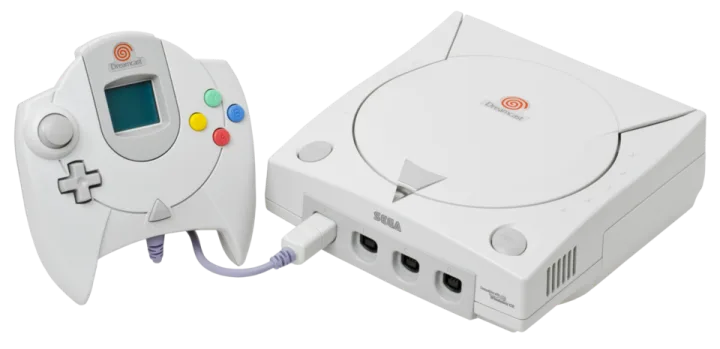
 Sonic Adventure
ソニックアドベンチャー
Sonic Adventure was Dreamcast's flagship launch title and the first mainline Sonic game to offer full 3D platforming. Players took control of one of six characters, each with unique abilities and storylines, as they raced to collect Chaos Emeralds and stop Doctor Robotnik's latest scheme.
What is it?
Sonic Adventure breaks from the series' traditional side-scrolling formula by placing the player in full 3D environments. Rather than a single protagonist, the game unlocks six playable characters over its course: Sonic, the blue hedgehog who runs at high speed; Tails, who can fly; Knuckles, who climbs and hunts for treasure; Amy, who wields a hammer; Big, a laid-back cat who fishes; and E-102 Gamma, a robot who fires laser beams. Each character has his or her own story, and their abilities shape how they tackle the game's levels.
The hub world, Station Square, serves as a base where players encounter NPCs, pick up jobs for extra content, and unlock new areas. The core loop involves entering action stages from the hub and completing character-specific objectives: Sonic must reach the goal, Tails must arrive before Sonic, Knuckles must find three emerald shards.
How it plays
Beyond the main story, Sonic Adventure introduces Chao Gardens, where players can raise digital creatures that grow stronger through minigames and feeding small animals collected during stages. Completing objectives earns emblems that unlock bonus content and new areas, extending the replay value and giving completionists a lengthy challenge. The Chao minigame, powered by the Visual Memory Unit, was a novel hook that let players raise their creatures on the go and compete them in races.
Movement is handled with the analog stick, and jumping is performed with a single button—this elegant simplicity preserved the intuitive feel of the original. Each character's differing playstyle changed the pacing: Sonic's levels emphasized speed and momentum; Knuckles' levels demanded precision puzzle-solving; Big's fishing stages were leisurely and experimental.
Why it sold / trivia
Sonic Adventure was bundled with the Dreamcast in some regions and arrived as a launch title in Japan, giving it maximum visibility. The game's visuals, starring realistic reflections and detailed character models rendered with cutting-edge 3D hardware, showcased what the Dreamcast could achieve. By August 2006, the game had sold 2.5 million copies worldwide, making it the console's bestseller and a rare bright spot during an otherwise bleak period for the system. The North American version sold 1.27 million copies alone, nearly half the game's total worldwide tally.
The game's development was rushed to meet the console launch, resulting in a final product packed with ideas but plagued by camera glitches and collision detection issues that persist in every version. Despite these flaws, critics recognized Sonic Adventure as a daring reinvention and a technical landmark.
Sources
- Best-seller list (English Wikipedia)
- Sonic Adventure (English Wikipedia)
- ソニックアドベンチャー (Japanese Wikipedia)
How it is ranked: Worldwide sales (from the English Wikipedia list)